
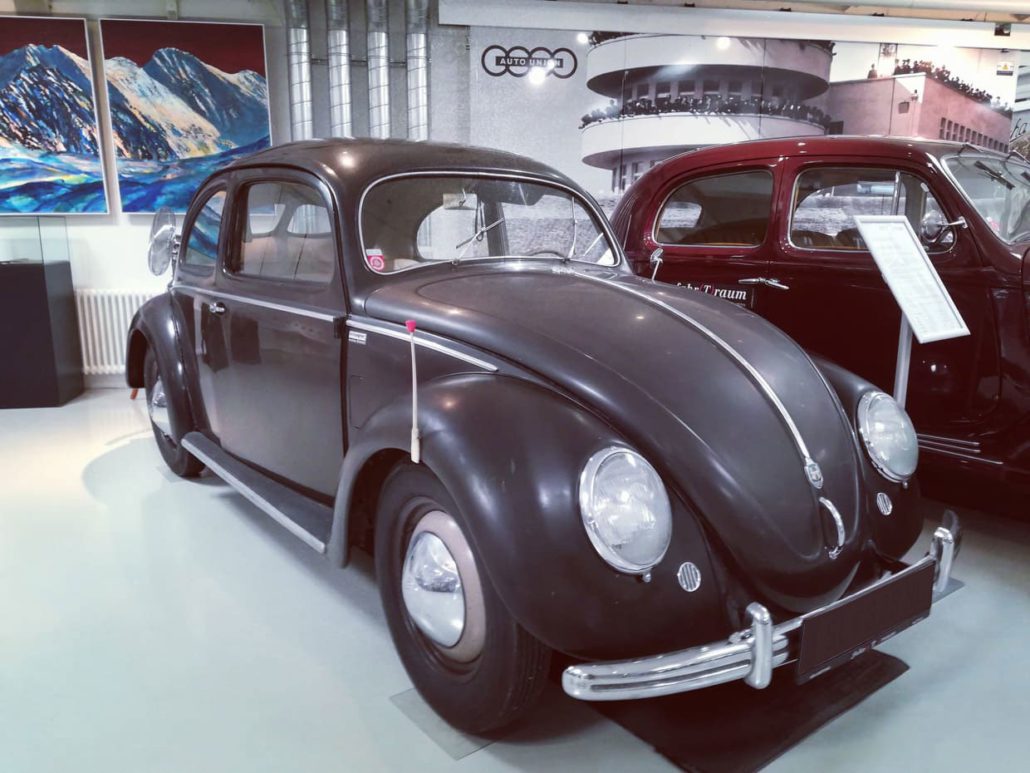
NEW unrestored 1952 Pretzel Beetle at fahr(T)raum
The Ferdinand Porsche Worlds of Experience fahr(T)raum has been enhanced by a special exhibit: a 1952 25 hp VW Pretzel Beetle in its original state; a rarity among collectors nowadays.
The nickname „pretzel beetle” is derived from the design of the rear window which, with its two semi-oval panes divided by a central bar, is reminiscent of the shape of a pretzel. The split window was not a design decision, but simply a financial consideration: a convex window pane that would have integrated into the curved rear would have been too expensive for the moderately-priced small car.
In 1934, Ferdinand Porsche was commissioned by the Reich Association of the German Automobile Industry to develop a fuel-efficient and economical car – a „Volkswagen”, later known as the „KdF-Wagen” (Strength through Joy car). In 1938, some pre-production cars were shown at exhibitions, but not yet delivered to customers. The specially built Volkswagen factory was only finished during the war.
 After the war ended in 1945 – the Volkswagen factory now in the British hands – the first mass-produced Volkswagen Type 1 were initially delivered only to the United Kingdom and the United States occupying forces and to the Deutsche Post. Production for the civilian population took place from 1948. Technically, the Beetle corresponded to the previous models: central tube frame with base plate made of sheet steel, torsion bar suspension, air-cooled four-cylinder boxer engine, top speed 100 km/h, curb weight 750 kg. Export to the USA after 1950 was a great success and the nickname „beetle” or „bug” came into fashion. In Germany, the term „Beetle” prevailed only from 1961 – in contrast to the VW 1500 notchback model (internally called Type 3).
In 1953, the split rear window of the pretzel beetle was replaced by a one-piece oval window made of slightly curved safety glass 23% larger than the two small panes. 1957 saw a larger rectangular rear window. One could also acquire the single rear window for installation in older models.
Nowadays, for nostalgic reasons, the divided rear windows are often fitted – using conversion kits that allow the previously cut-out central bar to be re-welded.
A total of 21,529,464 VW Beetles were produced until production ceased on July 30, 2003.
At fahr(T)raum one can now admire an unrestored Pretzel Beetle in its original condition from 1952. From 5 October 2019, a special exhibition on Beetle convertibles will also open. One of the first pretzel convertibles, meticulously and faithfully restored by Alexander Fritz, is the heart piece of the exhibition. Further information at: A beetle convertible | Special Exhibition
Quellen
https://de.wikipedia.org/wiki/Brezelk%C3%A4fer
https://de.wikipedia.org/wiki/VW_K%C3%A4fer
https://de.wikipedia.org/wiki/KdF-Wagen
http://www.vw-kaeferclub-kaernten.at/wp-content/uploads/2018/04/VW_Clubzeitung.pdf
Bilder, © fahr(T)raum
You might also be interested in:




Auto Union Type C – most successful German Grand Prix racing car in 1936!
/Kategória: Geschichte, Motoren, Rennautos, Uncategorized @huThe Auto Union Type C was the most successful German Grand Prix racing car in 1936. It won three out of five Grand Prix races, half of the circuit races and all hill-climbs in which Auto Union participated. In addition, the Type C set more than thirty world records. In order to minimise the financial […]
Austro-Daimler Maja 28/32 celebrates its 110th birthday
/Kategória: Geschichte, Motoren, Rennautos, Uncategorized @hu110 years have passed since Ferdinand Porsche developed the first purely petrol-driven car for Austro-Daimler – the AD Maja 28/32. In September 1906, Emil Jellinek, head of the Austro-Daimler company, brought in Ferdinand Porsche to Daimler in Wiener Neustadt as a new development manager and technical director for the construction of AD Maja. After only […]